There Will Be No Law or Regulation That Can Do Anything Against Gatekeepers

Colleagues, we are facing two critical weeks defining the next decade of our relationship with technology.

Our goal during this period of implementing the DMA, with your help, is to convey to the commission and regulators what the priority should be amid all the noise caused by the malicious compliance of the Gatekeepers.

We must warn them. Nothing in the law will have any effect if the main problem is not addressed: the pre-installation of gatekeeper stores on every mobile phone sold in Europe.

In everything proposed by Google and Apple, no single line addresses what should be the only concern at this moment for the industry.

The reason is that this simple fact leaves no room for competition and nullifies any other measure of the law. It’s useless to choose a default browser if it’s not available in the pre-installed store; the control of the Gatekeepers remains intact.

Moreover, Uptodown is one of Google Play’s most significant competitors. We deliver over 300 million downloads monthly and have 80,000 developers on board. And yet, we have less than one percent market share.

After a decade of absolute dominance, the truth is that an average user would not be able to name a single alternative to Google Play. This is the damage caused by the pre-installation of stores which, unfortunately, will soon be irreversible.

Google proposes that manufacturers should decide which store to pre-install. Manufacturers that depend on Google – Maps, Gmail, and all sorts of services unrelated to app distribution. Manufacturers that are, for this and other reasons, partners of Google. Manufacturers that have been Google’s tool to manipulate the market for a decade and that have incurred fines of up to 4 billion euros to Google for this reason. The commission must see the humiliation this proposal entails for competitors and regulators.

Google proposes that the user go out to look for an alternative, which they can do. Users abandoned for more than 10 years, unable to navigate the difficulties to even identify those who propose an alternative. No, this has not worked and will not work to correct this anomaly and the total lack of competition. There must be explicit consent, and alternatives must be presented on equal terms. We do not ask for special treatment.

We do not have much time; no law or regulation can do anything once independent stores disappear. These weeks will show what Europe’s response to the challenge will be. Good luck.

UPTODOWN’S RESPONSE TO THE CHANGES PROPOSED BY GOOGLE TO THE DMA

Having learned of Google’s official statement regarding the DMA yesterday, we find it wholly insufficient and ineffective for the purpose of The Digital Markets Act.

Google Play is the Android ecosystem’s primary gateway and most critical control mechanism. Any other measure of this law is invalidated if this problem is not addressed.

Uptodown is one of the largest independent app stores, yet it has less than one percent market share compared to Google Play.

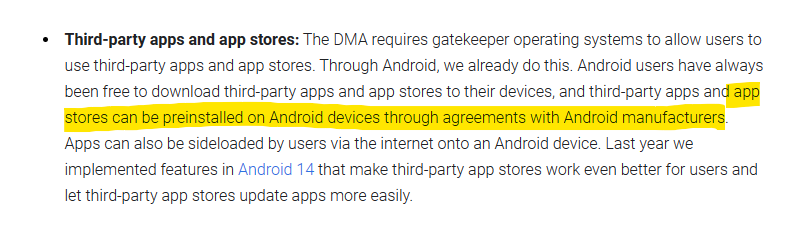
In its official statement, Google responds to this anomaly: «app stores can be preinstalled on Android devices through agreements with Android manufacturers”.

For over a decade, as demonstrated in various legal proceedings, Google has abused its relationship with manufacturers, making it impossible to adopt any alternative.

Antitrust: Commission fines Google €4.34 billion for illegal practices regarding Android mobile devices

Google offers its mobile apps and services to device manufacturers as a bundle, which includes the Google Play Store, the Google Search app and the Google Chrome browser. Google’s licensing conditions make it impossible for manufacturers to pre-install some apps but not others

In our opinion, it is not possible to correct this imbalance caused by 12 years of market abuse by leaving it in the hands of the judgment of manufacturers and Google’s partners. And by rendering ineffective the decision-making ability of end users exposed to these practices and agreements of the stakeholders.

Google Play cannot be preinstalled on any device sold in Europe without the explicit consent and transparent presentation of alternatives to the end users themselves.


Google Play’s position of dominance is such that, even if these changes in the app store selection were implemented today, we would need months, if not years, to restore competition. Alternative stores have so little market space that we do not have that time.

This is why additional changes not addressed by Google in its response to the DMA are required. Not allowing third-party stores on Google Play, the main gateway to the Android ecosystem, prevents the actual adoption of any other alternative.

To what extent is it fair, reasonable, and proportional for Uptodown, an app store that has been operating longer than Google Play itself, safer (Google Play malware clocks up more than 600 million downloads in 2023), and a 100% legal European company, to not be allowed on Google Play.

Yes, Uptodown is not allowed on Google Play as of today.

Google Play cannot block legal third-party app stores as a mechanism to prevent access to the Android ecosystem.


Until both previous conditions are practical, interoperability is the only tool to mitigate the damage Google is causing to competition.

The web plays a crucial role in making such interoperability effective and is being attacked by Google with the proposed changes to app distribution.

Google abandoned standards such as APK formats on Google Play in favor of others that depend on their platforms as intermediaries. Technologies like Dynamic Delivery or «Bundles» file formats do not allow the delivery of complete applications. They obscure what’s happening behind the Gatekeeper’s platform, thus making archiving and distribution by third-party stores and users more difficult.

These types of file manipulation from Gatekeeper’s stores and «on the fly» packaging also affect the use of signatures by developers, which may now be controlled by Gatekeepers and cause significant fragmentation.

Bundles limit the user’s ability to back up their apps and distribute them internally on their devices without the intervention of the Play Store.

Gatekeepers must always provide standard formats and transparent delivery (direct download of complete apps) in their stores as an alternative to end users in their platforms. 


Finally, none of the changes proposed by Google address the unnecessary frictions involved in using sideloading, whose sole purpose is to hinder the adoption of any other source of applications.

This includes:

Overly exaggerated warning messages that are not used in Google’s own services.

The ease of authorizing and accessing the necessary permissions in the operating system for sideloading applications.

Access to operating system operations allowed for Google Play but not other stores, such as automatically updating applications from other sources.

Google must ensure the same treatment and access to operating system functionalities for third-party stores.

Read and share the full document here.

Digital Markets Act Status

I am receiving many inquiries from developers, users, and colleagues about the impending European Digital Markets Act.

With two weeks left until the deadline for Gatekeepers to comply with the DMA obligations, here is where we stand.

GOOGLE

We have no information on the requirements to be listed as an alternative service to the store that is pre-installed by Google and manufacturers.

We are unaware of the procedures for users to choose their application store and give consent, such as the selection screen, the way alternatives are presented, descriptions, ordering, and criteria for selecting candidates.

There is no public information, nor have we received any communication from Google about the technical changes necessary to adapt to any other requirement, forcing us to improvise when the time comes.

Uptodown remains excluded from the Google ecosystem and blocked in Google Play despite being a completely legal store operating worldwide for over 20 years.

In short, no matter how much we have tried, nothing has changed regarding our situation, with just a few days left until the end of this period.

APPLE

In this case, there is somewhat more transparency regarding information about alternative stores.

Apple has published the requirements for developing stores on iOS and established some communication channels.

As is well known, these requirements do not make sense within the spirit of the law.

Uptodown’s developer profile has not yet been authorized for no apparent reason.

In any case, Uptodown could not meet the arbitrary credit and payments requested to operate its free application store on iOS.

Uptodown does not have editorial freedom; therefore, the law is ineffective for users, as the proposed solution allows them to control content.

So we can say that the situation is similar to that of Google, in practical terms, and with days left to meet the deadline, it is impossible to compete on iOS or operate any alternative to Apple’s services.

NO, your phone is not a damn toaster

It’s sad to see how giant companies refuse to take any responsibility or care for their own industry. Even if it’s because of how they started, what conditions of freedom and neutrality they found when they were founded, and what future they are proposing to us.

It’s sad to see Apple‘s reaction. Like that of a capricious child who intends to comply, not because he believes in the essence of what is being asked of him, but only to be able to continue abusing without being disturbed.

Relax Apple and Google. The Apple Store and Google Play are great products, the best. Why that fear of competition? They are not going to disappear, they will not be at risk. Trust in your work.

It’s sad the response from Spotify or Epic, focusing the debate on the commissions. Getting outraged when at the same time they send their DMCAs to other independent, legal, and transparent stores, without any reason.

Europe must not be deceived by entering into the price discussion. That’s not what we need. We ask for real neutrality, effective sideloading, freedom for developers to distribute their products under their conditions in direct relation to their users, the right to decide the source of your applications on your own device. Not whether Apple continues to regulate content or approve its own competition, even if it’s at zero cost.

It’s sad the response from a large part of the community. NO, your phone IS NOT a damn toaster. It’s a key element in the value chain for accessing all the information you consume. It’s not even a specific-purpose device like consoles. It does NOT exclusively have platform-dependent applications.

NO, we don’t want your grandparents to use third-party stores or engage in sideloading if they don’t want to. It doesn’t change the status of those who want to remain under the total control of the big companies.

No friends, the solution is not that you build your own device and your own operating system if you want to share your work as a developer under your conditions. If a group of telecom companies had decided 40 years ago that they were building the networks and protocols, that they had the right to charge and control what happened on the internet, Apple and Google would have nothing today.

It’s sad that in this hostile environment, small companies like Uptodown and so many others whose purpose is to offer more tools to organize the complex world of software, may not survive much longer.

The rise of alternative app stores

The world’s first publication on mobile gaming conducts an exhaustive review of Uptodown’s role in the upcoming decade. The earthquake that is going to occur with its epicenter in Europe in the distribution of mobile applications:

https://www.pocketgamer.biz/interview/81711/uptodown-ceo-luis-hernndez-on-the-rise-of-alternative-app-stores/

In the early 2000s, we sought a way to connect app developers with users as directly and easily as possible. Our obsession was sorting out all the information about software and making it available to everyone with just one click.

-2010- At that time, Google and Apple also found value in the distribution of apps, proposing their stores as intermediaries between users and developers. The battle that raged for the next ten years focused on building walls around their gardens.

Without realizing it, we all assumed that it was impossible to publish an update without the permission of the big stores, that we could not agree on conditions and offers directly with our own users, and sell on our own website without assuming consequences.

It was too late when they discovered that the same company that imposed its own hardware, operating system, ads, monetization/payment systems, browser, or search now also wanted to control the content.

It has been challenging to counter Google and Apple’s marketing about the danger of anyone else distributing apps. But our mission remains intact. We develop tools to ensure free access to software and organize information from apps worldwide.

Against this model, Uptodown defended the web as the most valid, accessible, and transparent platform to obtain apps.

Happy that this year our colleagues and friends have helped us fight. No matter what happens at the end of this process, we will have tried.

Gatekeeper strategies to bypass interoperability and FRAND practices

After listening to our colleagues in the app distribution industry for the past few weeks (stores, developers, regulators) and leveraging our 15-year expertise in the Android domain, we have identified three key obstacles preventing mobile devices from becoming a thriving space of opportunities.

These challenges involve effectively regulating and fostering essential interoperability, ensuring adherence to industry standards, and promoting editorial freedom among gatekeepers.

1. Platform Level

Due to their significant influence over developers, Gatekeepers can indirectly hinder effective interoperability.

An example of how gatekeepers operate at this level. Google implements new features in their platforms, such as «Update Ownership» (soon coming to Android 14), promoted as a tool for app stores and developers to block updates from another store or even Google Play. 

Once implemented, Google Play could also use this API to take ownership of updates over apps they install, thus hindering sideloading updates.

Such features mean powerful tools in the hands of stores with an enormous market share and influence over developers, creating new barriers to interoperability with no real user value.

Gatekeeper position:

  • Developers can freely choose their distribution strategy. 
  • We actively propose improvements for third app stores.

Problem:

  • Big platforms have a vast influence over developers to shape the industry to Gatekeeper’s benefit, even without explicit incentives for developers to adopt these technologies.
  • The same features have different adverse effects in completely unbalanced markets. Decisions supposedly made in favor of third-party stores fail to repair imbalances and potentially consolidate the large platforms’ dominant position.

Possible solutions:

  • Gatekeepers cannot deploy features on their platforms, even as a developers’ decision, which may affect the user’s higher right to interoperability.
  • The users’ right to interoperability must be protected and precede the interests of gatekeepers and even developers (influenced by large platforms).

2. App Store Level

Their dominant position enables them to impose technologies and eliminate standards on their stores for the same purpose, indirectly breaking interoperability.

Several technical decisions, even in their Stores, significantly affect interoperability in the whole mobile ecosystem. For instance, Gatekeepers abandoned standards such as APK formats on Google Play in favor of others that depend on their platforms as intermediates. 

Technologies like Dynamic Delivery or «Bundles» file formats do not allow the delivery of complete applications. They are blind to what’s happening behind Gatekeeper’s platform—thus making archiving and distribution by third-party stores and users more difficult.

These types of file manipulation from Gatekeeper’s stores and packaging “on the fly” also affect the use of signatures by developers, which now may be controlled by Gatekeepers and cause significant fragmentation.

Gatekeeper position:

  • We make distribution faster and save some space by optimizing file formats and delivery technology.

Problem:

  • They propose marginal benefits without considering the severe impact of these technologies over interoperability in the long term.
  • Bundles limit the user’s ability to back up their apps and distribute them internally on their devices without the intervention of the Play Store.

Possible solutions:

  • They always have to provide standard formats and transparent delivery (direct download of complete apps) in their stores as an alternative to end users in their platforms. 
  • They have to make a public repository of every content not manipulated by the platform as an alternative to their delivery technologies.
  • The developer, not intermediate stores, should manage the deliverable files. The EU should limit the possibility of repackaging by stores, leaving everything in the hands of the developer. Bundles save space, with the tradeoff that developers give Google the app-signing keys.

3. Content Level

In addition to these technical decisions, Gatekeepers add other content-level decisions to justify avoiding FRAND conditions. 

They refer to the potential content that third-party stores can distribute, which would not allow their presence on their devices or stores. Gatekeepers can easily justify not allowing competitors with massive content based on non-compliance with their arbitrary content policies.

The editorial freedom of other stores must be guaranteed, and the decision to block specific content should not be left in the hands of interested parties (and never at the store/platform level).

Gatekeeper position:

  • We have the right to block or ban entire platforms without limitation on our store if we consider any of their content could be a potential “risk” for users.

Problem:

  • The definition of «risk» is crucial in determining whether certain apps are banned from app stores (in any case, full stores). While certain risks like viruses and data theft are legitimate, banning apps based on political or moral considerations is questionable. Ultimately, users should have the freedom to choose which apps to use, rather than being restricted by the choices of the OS maker.
  • Alternative stores manage a high number of studios and massive content. Even Gatekeepers would not comply with any requirement based on cherry-picking over millions of files and thousands of studios. 
  • This will cause a loss of content diversity.

Possible solutions:

  • Gatekeepers cannot ban stores based on the legal content third-party stores distribute, even if this content does not fit their content policy. 
  • Access to content through alternative app stores not controlled by gatekeepers should be a protected digital right.
  • Exceptional store-level banning must be validated by a third party, possibly an app store consortium.

Download and share our conclusions here.