We’ve launched Uptodown’s Transparency Center: a public view of how we handle threat control, developer quality, governance and community. Real data, updated every month.
If you use an app store today, you’re probably flying blind.
You don’t really know who is uploading what, how those files are checked, what gets rejected, or why something disappears. App distribution has become a black box.
At Uptodown we’ve always believed the opposite:
If you want people to trust you, show them how everything works.
That’s why we’ve launched the Uptodown Transparency Center – a public space where we expose how we run the store: threat control, developer reviews, governance, community, and historical metrics. Real numbers, updated regularly, not marketing slides.
Threat control you can actually see
Every file we host goes through VirusTotal, with detection engines from more than 75 antivirus vendors (Kaspersky, Bitdefender, Avast, McAfee, AVG, etc.). We use those reports as a first line of defense, and then our Editorial team makes the final call.
In the latest period we analyzed 2,355,401 unique files with VirusTotal.
- 92.38% had zero detections
- 6.36% had 1–3 detections
- 1.25% had 4 or more detections
Some categories (emulators, root tools, customization apps) naturally trigger “false positives”, and we explain that openly. For every app, users can read the VirusTotal report themselves from the file page.
Security isn’t a mystery here. You can literally click and audit our decisions.
Quality over quantity for developers
We love developers—but we don’t publish everything.
Right now we have 191,273 registered developers, and in the last month alone:
- 2,216 apps from registered authors were uploaded
- 1,558 submissions or updates were rejected
Why do we reject them? The main reasons:
- Not meeting minimum quality standards – 48.97%
- Low-quality webviews – 8.34%
- Using templates that clone existing apps – 3.66%
- Dangerous apps – 2.05%
- Other reasons (rest of official criteria) – 36.97%
This is the opposite of “anything goes”. We prefer a tighter, safer, more useful catalog over raw volume. Everyone sees where we draw the line.
Scale, but not as a black box
Uptodown today:
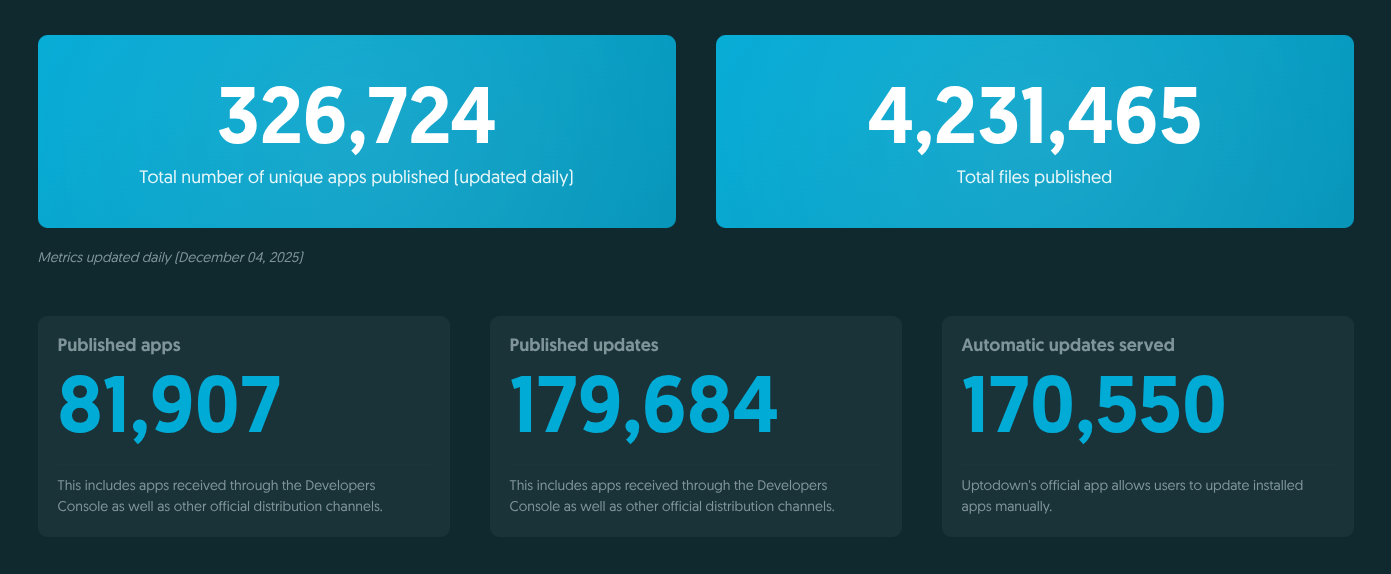
- 326,724 unique apps published
- 4,231,465 files in total across platforms
- 81,907 apps and 179,684 updates published in the latest period
This is one of the most complete pictures of app distribution outside Google Play you can find in one place.
If you want to understand what’s happening in independent app distribution, the Transparency Center is basically our live dashboard.
Governance, takedowns and legal responsibilities
Another black-box area in app stores is governance:
- What happens when someone reports a copyright issue?
- How many apps get removed?
- How fast do you react?
We handle removal requests (DMCA-style and similar) with a clear and documented process, and we also expose the numbers: in the latest period, 103 apps were withdrawn due to legal requests.
We also process profile deletion requests and treat user data with the same respect: clear channels, documented flow, and visible impact in the Transparency Center.
Community as a safety layer, not just “engagement”
Our community is huge, but again, not opaque:
- 45,784,466 registered users
- 1,134,015 new users in the last period
- 52,742 ratings and 14,143 comments published
- 21.16% of comments are rejected by our anti-spam + manual moderation layer.
We don’t treat comments as “free content”; we treat them as another safety layer. The moderation pipeline (automatic + editorial) is there to keep things useful and respectful—and the rejection rate is public so you know we actually act on it.
Why we’re doing this
Because we believe in a simple idea:
If an app store wants your trust, it should earn it in the open.
Uptodown is an independent, multi-platform app store built around that idea: open access, transparent stats, visible governance, and safety you can inspect—not just a logo that says “secure”.
Yes, you can be open and trustworthy.
Yes, you can be transparent and safe.

 @luishg